PLAYER PROFILE: “Wild Bill” Hickok

James Butler Hickok died holding two pair, aces and eights, in a Deadwood saloon in August 1876, a hand that would later become known across poker tables everywhere as the Dead Man’s Hand. Long before that, though, he’d already built one of the most storied reputations of the American frontier: gunfighter, lawman, army scout, and briefly, stage actor.
The Origins of a Legend
James Butler Hickok was born on May 27, 1837, in the small town of Homer, Illinois, now known as Troy Grove.
James’s father, William Alonzo Hickok, was an abolitionist, and the family farm in Illinois is said to have served as a stop on the Underground Railroad, a covert network that helped enslaved people escape to freedom.
Growing up in a household shaped by his father’s convictions, young James Butler Hickok was naturally drawn to tales of heroism and adventure. The stories of frontier life, with its challenges, opportunities, and raw, unbridled spirit, captivated his imagination and set the stage for his transformation into one of the era’s most talked-about figures.
👉 Use Referral Code: WINBIG 👈PLAY NOW!
The Formative Years
At 17, Hickok left home, working as a canal boat pilot before heading to the tumultuous border war known as Bleeding Kansas in 1856. Here, he joined the Free State Army of Jayhawkers, serving as a bodyguard for General James H. Lanes. It was during this period that he saved an 11-year-old boy from a beating. This boy would later become the renowned Buffalo Bill Cody, a lifelong friend of Hickok.
Hickok’s reputation for courage and fairness led him to various roles, from a constable in Monticello, Kansas, to a teamster for the creators of the Pony Express. One notable incident from this period was his encounter with a bear. After a fierce struggle, he managed to kill it, but not without sustaining severe injuries.
However, it was the shootout at Rock Creek in 1861, often referred to as the McCanles Massacre, that significantly contributed to Hickok’s growing legend. The details of this event have been debated, but it’s clear that Hickok played a central role in the confrontation, further cementing his reputation as a formidable gunfighter.
The Rise of “Wild Bill”
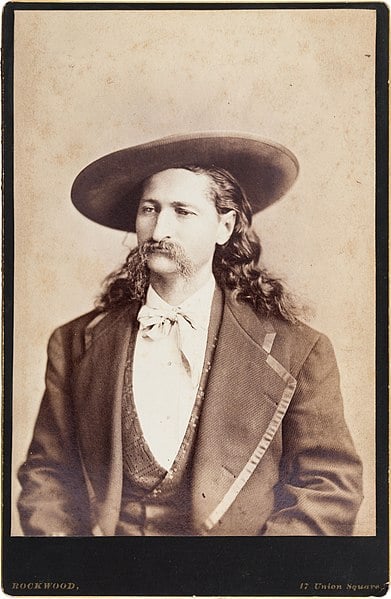
Hickok’s service during the Civil War showcased his versatility. He served as a spy, scout, and sharpshooter for the Union army. His daring feats during this period might have earned him the moniker “Wild Bill.” Post-war, Hickok’s adventures continued. He guided tours for notable figures like General William T. Sherman, scouted for General Winfield Scott Hancock and Lieutenant Colonel George Armstrong Custer, and even became sheriff of Hays City, Kansas.
His physical appearance was striking, with descriptions highlighting his tall stature, long locks, and distinctive facial features. Despite his rugged exterior, Hickok was known for his genteel manners, courtesy, and a penchant for dressing in the latest styles.
The Gunfighter, the Actor, and the Legend
James Butler “Wild Bill” Hickok, a name synonymous with the Wild West, was renowned for his unmatched skill with firearms. His reputation as a gunfighter was not just based on hearsay but was cemented by real-life encounters, the most notable of which was his face-off with David Tutt in Springfield, Missouri. This duel, which saw Hickok emerge victorious, added another layer to the growing legend of Wild Bill, cementing his reputation as one of the era’s most talked-about gunfighters.
But Hickok’s life was multifaceted, and his interests extended beyond the world of gunfights and duels. In a fun turn of events, he ventured into the realm of entertainment, joining forces with another iconic figure of the West, Buffalo Bill Cody. Together, they staged “The Scouts of the Prairie,” a theatrical production that aimed to bring the adventures of the frontier to the stage. While this foray into acting offered Hickok a respite from the perils of his previous life and a chance at financial stability, it became evident that the stage couldn’t contain his spirit. The call of the West, with its vast landscapes and untamed wilderness, was irresistible, and Hickok yearned to return to the life he knew best.
The Final Years in Deadwood
The year 1876 marked a significant chapter in Hickok’s life. Having tied the knot with Agnes Lake Thatcher, a talented circus performer with a life as colorful as his own, Hickok set his sights on the promise of wealth in the Black Hills’ goldfields. This quest for fortune led him to the bustling town of Deadwood in South Dakota. Deadwood, with its maze of saloons, gambling dens, and a populace driven by ambition and desperation, was a microcosm of the Wild West.
Despite the challenges posed by deteriorating eyesight, Hickok’s reputation preceded him, and he took on the role of a peace officer in Deadwood. His legendary status, combined with his innate sense of justice, made him a figure of authority in the chaotic town.
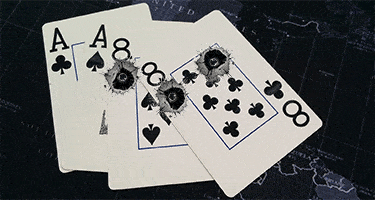
Yet, destiny, often unpredictable, had a tragic twist in store. On a fateful day in August 1876, as Hickok was engrossed in a game of poker, a treacherous act ended his life. Jack McCall, for reasons that have been the subject of speculation and debate for over a century, shot Hickok from behind. In that moment, Hickok was holding a pair of aces and a pair of eights, which has since become infamously known as the ‘Dead Man’s Hand’ in poker lore. With that fatal shot, the curtain came down on the life of Wild Bill Hickok. But while his life was tragically cut short, the legend of Wild Bill Hickok, with its tales of bravery, adventure, and intrigue, continues to live on, immortalized in the pages of history.
The Legacy of Wild Bill Hickok
James Butler Hickok was a gunslinger, a lawman, and by the end, a gambler holding a pair of aces and a pair of eights when Jack McCall shot him from behind. Whatever else gets debated about his life, that hand in Deadwood is the detail that turned him from an Old West figure into a permanent fixture of poker history.
Note from the Editor:
The world as we know it has changed immensely compared to what the gamblers of the first half of the 20th century experienced. There were no cell phones, or internet. Automobiles were just starting to become common and affordable trans-Atlantic flights were still a bit into the future. Computers and space travel were as far removed from society as dragons and fairies. Information was not as accessible as it is today. Because of this, and a gambler’s penchant to miraculously forget anything and everything as part of an unwritten code, many of the stories and anecdotes that come from the time could be full of hyperbole and may not be entirely faithful or accurately represent what occurred. However, the oral histories we have, as told through the years, are now all that remains of this ancient time. If any of the tales are inaccurate or outright lies, know that this was neither intentional, nor the intent of the article.
-The Wordsmith,
Updated on Dec. 6, 2022
About the Author: Shawn Altbaum has been writing and editing in the online gaming industry since 2007, reporting live from the WSOP Main Event and conducting interviews with professional players. An active poker player, he combines industry expertise with firsthand knowledge of the games he covers. He currently serves as Global Head of Copywriting at NSUS Group, overseeing brand voice and content strategy across GGPoker and GGVegas.
Dive into the world of online poker with GGPoker, the platform trusted by players chasing poker greatness. Take part in thrilling multi-table tournaments, intense cash games, or legendary events like the WSOP bracelet and WSOP Circuit ring series. Learn with free poker games from GGPoker School, and enhance your gameplay with Smart HUD and PokerCraft. With a wide range of poker formats and in-depth analytics, GGPoker equips players with everything they need to sharpen their strategies, manage staking, and compete for meaningful prizes.