Poker Glossary – B
Welcome to the GGPoker Poker Glossary — your complete reference for poker terms and concepts. Use the jump links below to navigate, or browse the full list alphabetically.
0-9 & A | B | C | D | E-F | G-H | I-L | M-N | O-P | Q-R | S | T | U-W
Backdoor | Backer | Back Into | Back Raise or Backraise | Bad Beat | Bad Beat Jackpot | Badugi | Balance | Bankroll | Bankroll Management | Barrel | Belly Buster | Bet | Bet Into | Betting Structure | Betting Pattern | Big Blind | Big Blind Special | Big Blind Ante | Big O | Big Slick | Big Stack | Blank | Bleed | Blind | Blind Defense | Blind Steal | Blocker | Blocking Bet | Bluff | Bluff Catch | Bluff Catcher | Bluff Catching Range | Bluff Induce | Board | Boat | Bomb Pot | Bottom End | Bottom Pair; Bottom Set | Bounty | Bounty Hunters | Boxed Card | Bracelet | Brick | Brick-and-Mortar | Bring-In | Broadway | Broomcorn’s Uncle | Brush | Bubble | Buck | Bug | Bullet | Bullets | Bump | Burn | Burn Card | Bust Out | Busted | Busto | Button | Buy-In | Buy Short | Buy the Pot | Mystery Battle Royale
Backdoor |
A drawing hand requiring two or more cards to complete. When a player makes a hand that they did not intend to or were expecting to make. |
Backer |
An investor who bankrolls, either in part or in full, a player in exchange for a percentage of any profits from the session. Backing (the act of being a Backer) allows players to play at higher stakes than they would normally would. If the player loses money, then the Backer is the one who absorbs the loss. Also known as a Staker. |
Back Into |
To win a pot with a hand you didn’t intend to play for value – usually a secondary draw that completed while you were chasing something else. For example, flopping a 4-card flush, drawing the wrong color on the turn and river, but going runner-runner and nailing the straight instead. |
Back Raise or Backraise |
A move where a player first calls an opponent’s bet, then raises when the bet comes back around to them on the same street. This is an advanced technique, usually done to trap or bluff the opponent into thinking they have the stronger hand. |
Bad Beat |
Suffering the outcome of bad luck in poker. Most commonly this occurs when a great starting hand loses to a statistically weaker starting hand by catching just the right cards, such as getting it all in with pocket aces against pocket kings, only for the kings to make a full house on the river. The opposite of a Suck Out. |
Bad Beat Jackpot |
A bonus prize that is paid out when a very strong hand, typically aces full or better, loses to an even stronger hand at showdown. There are almost always specific rules regarding what hands count towards a bad beat, the number of cards from each player’s hand that must be used, and the betting — all of which may change based on the game and venue. Generally, and at the very least, both the winning and losing hands will have to use both hole cards. The player that loses the hand will typically receive the largest share of the jackpot, with additional shares distributed to the winner and other players at the table. |
Badugi |
A lowball draw game played with 4 hole cards. The goal of the game is to make the lowest 4-card hand without pairs or duplicate suits. The best possible hand, known as a badugi, consists of A-2-3-4 with each card in a different suit. Hands with four unique ranks and suits beat three-card hands, which beat two-card hands, and so on. If two hands contain the same number of playable cards, the lower hand wins. Badugi commonly appears in mixed game rotations such as 8-Game and is occasionally spread alone, particularly at higher stakes. |
Balance |
Balance is the practice of playing strong hands, weak hands, and bluffs similarly enough that opponents cannot easily assess the hand you are holding. |
Bankroll |
1) Noun – The amount of money a player has set aside for the purposes of playing poker. 2) Verb – Funding part of all of another player’s participation in a game or tournament. |
Bankroll Management |
The practice of putting aside a set amount of funds for gambling, particularly poker, and consistently playing at stakes proportionate to that amount. Standard guidelines suggest 20-30 buy-ins for cash games and 50-100 buy-ins for tournaments, given tournament variance. Playing above your bankroll increases the risk of ruin, even when you have an edge over the field. Proper bankroll management is necessary for sustainability in poker, instead of gambling on the outcome of individual sessions. |
Barrel |
A term for a post-flop bet, most commonly used when a player makes consecutive bets across multiple streets (e.g., Flop, Turn, and River) to maintain betting momentum. |
Belly Buster |
A straight draw where the missing card falls in the middle of the sequence – also called a gutshot. Harder to complete than an open-ended draw, due to fewer outs. |
Bet |
Any chips or money voluntarily placed into the pot during a hand. Specifically, the first wager of a betting round – as opposed to a call or raise made in response to someone else’s action. |
 |
|
Bet Into |
To lead with a bet against a player who held the betting initiative on the previous street. You’re betting into them rather than checking and letting them act first. |
Betting Structure |
The specific rules governing how much players can bet or raise during a hand. The structure includes factors including the minimum and maximum bet amounts, number of allowed raises and types of bets permitted. |
Betting Pattern |
The sequence of bets or raises a player makes during a hand. This can unintentionally provide information to other players about hand strength, play style, and other tendencies. |
Big Blind |
The larger of the rotating forced bet which is made before cards are dealt. |
Big Blind Special |
A weak starting hand that is won by the big blind player, typically due to lack of pre-flop betting action. |
Big Blind Ante |
A tournament structure where the ante is consolidated into a single forced bet posted by the player in the big blind position each hand. This is a change to the traditional ante which is posting by each player separately on every hand. By having the big blind play for the table, each hand will be played a bit faster. |
Big O |
A variant of Omaha using 5 hole cards instead of 4. Like standard Omaha, players must use exactly 2 hole cards and exactly 3 community cards to make their best hand. The extra card significantly increases hand combinations, draw frequency, and average pot sizes. Usually played hi-lo with an 8-or-better qualifier for the low. Popular in high-stakes mixed games and increasingly available on major online platforms. |
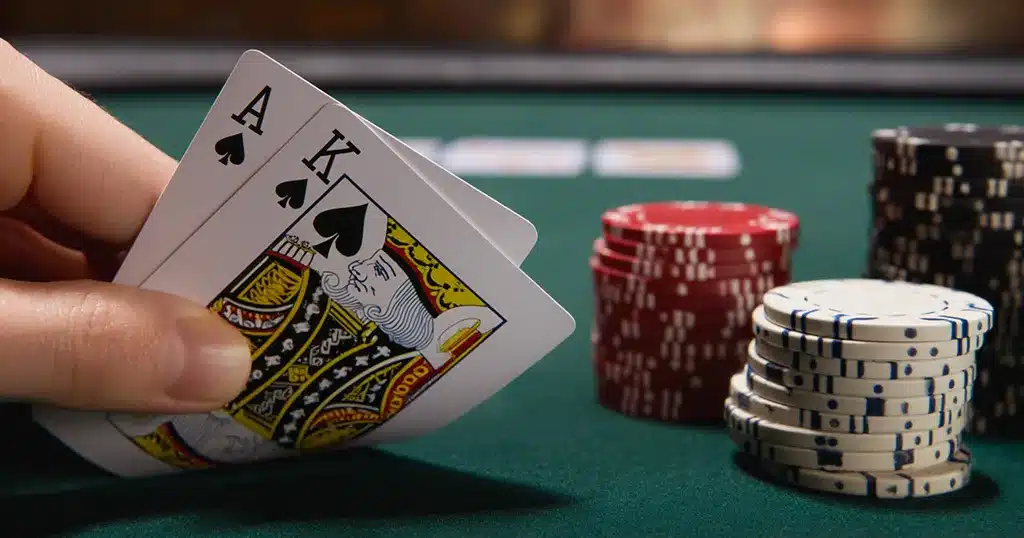
Big Slick |
A 2-card starting hand consisting of an Ace and a King. |
Big Stack |
The player currently holding the most chips at the table relative to everyone else seated. The big stack at a table has leverage: the ability to put any opponent to a decision for all their chips without risking elimination. See also: Deep Stack. |
Blank |
Also known as a Brick or a Rag, a Blank is a community card that is unlikely to have improved any players hand. |
Bleed |
The act of losing chips steadily over time for any combination of a variety of reasons including poor play, bad luck, strong opponents, tilt, or more. |
Blind |
A forced bet posted before cards are dealt, generally required from the two players immediately left of the dealer button. The small blind (immediately left of the Dealer) and big blind (immediately left of the Small Blind) rotate around the table each hand. |
Blind Defense |
Choosing to call or re-raise when someone raises into your big blind, rather than folding. Since you’ve already invested chips, the math often justifies a wider defending range than you’d play from other positions. |
 |
|
Blind Steal |
A raise from late position intended to pick up the blinds without a fight. It works best when you’re on or near the button and the players who posted the blinds are likely to fold. |
Blocker |
Holding one or more of an opponent’s potential outs, typically referring to when the board shows a draw. |
Blocking Bet |
A small bet made out of position to control pot size and discourage a larger bet from your opponent. |
Bluff |
To make a bet or raise with a weak hand in order to deceive opponents into thinking you’re strong and hoping they will fold. |
Bluff Catch |
A call made by a player with a weaker hand, often made in hopes of catching an opponent who is attempting to bluff or represent a stronger hand. |
Bluff Catcher |
A hand strong enough to beat a bluff but not strong enough to beat a legitimate value hand. When an opponent’s range is polarized – they either have a very strong hand or completely missed – a bluff catcher has just enough equity to make calling correct if the bluffing frequency is high enough. Middle pair or bottom pair often functions as a bluff catcher on the river. The key calculation is whether the opponent’s bluff-to-value ratio justifies the call. |
Bluff Catching Range |
The range of hands a player may choose to call with when attempting to catch an opponent’s bluff. This range typically includes weaker hands that would not normally be played aggressively, but are strong enough to justify a call based on the situation and the likelihood of an opponent bluffing. |
Bluff Induce |
A strategy used by a player to encourage their opponents to make a bluff by playing passively while having a strong hand. |
Board |
The shared cards in any game with community cards are collectively called the board. In Texas Hold’em it is the five cards which are dealt face-up in the center of the table across three streets: the flop, the turn, and the river. |
Boat |
See Full House. |
Bomb Pot |
A hand where every player at the table posts a predetermined ante, normally much larger than the blind or ante, before cards are dealt, with no preflop betting action. Players go directly to the flop with a large pot already built. Bomb pots generate immediate action and larger average pots. Frequency and ante size are agreed upon by the table; they are optional in most rooms but have become a standard feature in high-action live games and streaming sessions. |
Bottom End |
The lower range of possible straights that can be made in a given hand, quite vulnerable to higher ranking straights. |
Bottom Pair; Bottom Set |
When a player makes a pair or a set from the lowest community card on the board. |
 |
|
Bounty |
A feature of certain tournaments, rewarding players for the elimination other players. There is a cash prize for each player they eliminate, which is separate from any payout from the tournament. |
Bounty Hunters |
GGPoker-exclusive Bounty Tournaments with a progressive bounty structure, ensuring that you’ll collect a bounty with each knock-out made. The more players someone eliminates, the bigger their bounty becomes! |
Boxed Card |
A card that is face up in a deck, often the result of a bad muck and/or shuffle. The card can be set aside or the hand could be called a misdeal. |
Bracelet |
A gold bracelet awarded to the winner of any World Series of Poker (WSOP) event, and widely regarded as the most prestigious prize in poker. Equivalent to winning a cup or a belt in other sports. |
Brick |
Also known as a Blank or a Rag, a Brick is a community card that is unlikely to have improved any players hand. |
Brick-and-Mortar |
A real-world physical establishment or casino rather than an online virtual one. |
Bring-In |
A forced bet used in stud games to start the betting on third street. In most stud games, such as Seven Card Stud, the player showing the lowest upcard (door card) must post it. In lowball stud games like Razz, the rule is reversed and the player with the highest upcard brings in. When two players tie, suit order breaks it (clubs lowest, then diamonds, hearts, spades). |
Broadway |
The highest possible straight: Ten through Ace (10-J-Q-K-A). Also used loosely to describe any high cards in the Ten-to-Ace range. |
Broomcorn’s Uncle |
An overly tight player who folds so many hands that the antes slowly drain their stack before they ever play a pot. The term comes from the idea of being “anted to death.” Example: “He’s going the way of Broomcorn’s Uncle. |
Brush |
A poker room employee who manages the waiting list and seating, calling players to open seats as they become available and helping the game run smoothly. |
Bubble |
The point in a tournament just before payouts begin. The player who busts one spot short of the money goes out “on the bubble” and wins nothing. |
Buck |
An older term for the dealer button, the disc that marks the player acting as dealer for that hand. See also: Button. |
Bug |
A limited wild card, than can only be used to represent an Ace or the missing card in a straight, flush or straight flush. |
 |
|
Bullet |
A single buy-in into a tournament. In re-entry events a player can “fire” more than one bullet, meaning they re-enter after busting. |
Bullets |
A starting hand consisting of two Aces. Also called: Pocket Rockets, American Airline, Snake Eyes and more. |
Bump |
An informal term for Raise. |
Burn |
To remove the top card of the deck face down, and out of play, before dealing the flop, turn, or river. The dealer burns a card on each street. |
Burn Card |
The card removed and set aside during a burn. Burning protects the game by ensuring no player can gain an advantage if the top card’s identity is somehow known, such as from a mark, a defect, or a card being accidentally exposed. |
Bust Out |
To lose all of one’s chips, typically to be eliminated from a tournament. |
Busted |
1) A drawing hand that failed to complete, such as a busted flush draw or busted straight draw. 2) Having lost all your chips; broke. |
Busto |
Slang for a player who has lost their entire bankroll, not just the chips in front of them. Broke to the point of being unable to play. |
Button |
The physical marker, typically a white disc labeled “Dealer,” that indicates who holds the dealer position for a given hand. It rotates clockwise each hand, and the player holding it acts last on every post-flop street, the strongest positional advantage at the table. Also known as Dealer Button or On the Button. |
Buy-In |
The cost required to take a seat at a cash game or enter a tournament. Cash games typically have minimum and maximum buy-in amounts; tournaments have a fixed cost. |
Buy Short |
Entering a game with less than the standard buy-in amount, usually permitted down to a set minimum. |
Buy the Pot |
A strategy in which a player makes a large bet in the hopes of forcing all other players to fold, thereby winning the pot without having to show their cards or compete in a showdown. This tactic is often used when there isn’t much action and it appears the other players have weak hands. |
Mystery Battle Royale |
A GGPoker-exclusive tournament format. It’s an 18-player Sit & Go played in two stages, a fast-fold Rush stage followed by a Final Table, where mystery bounties are awarded for every knockout. |
👉 Use Referral Code: WINBIG 👈PLAY NOW!
About the Author: Shawn Altbaum has been writing and editing in the online gaming industry since 2007, reporting live from the WSOP Main Event and conducting interviews with professional players. An active poker player, he combines industry expertise with firsthand knowledge of the games he covers. He currently serves as Global Head of Copywriting at NSUS Group, overseeing brand voice and content strategy across GGPoker.